
Market Replay Trading Simulator for Better Decisions
A market replay trading simulator lets traders rehearse real sessions, test rules, and review decisions before capital is exposed to live risk daily.
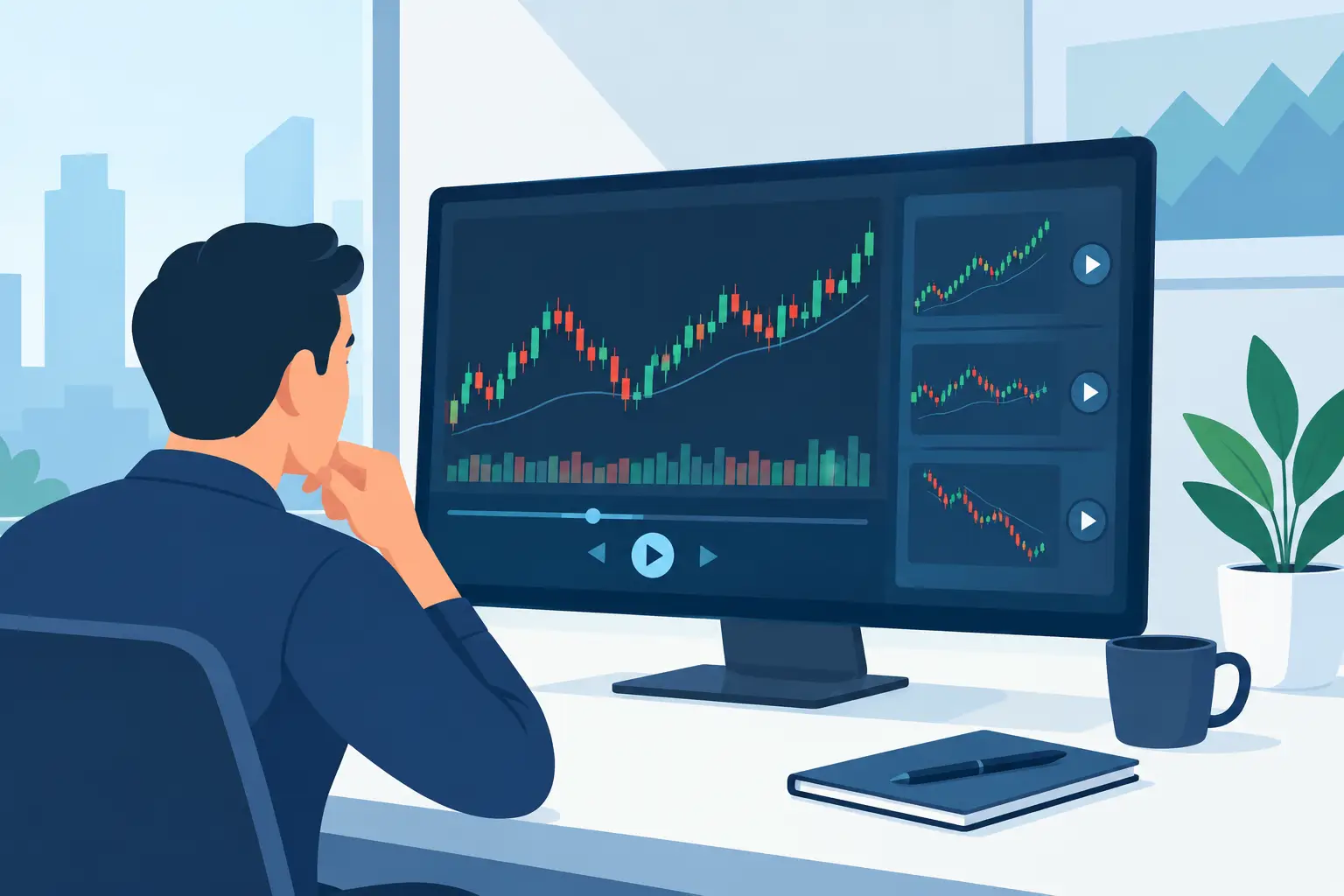
A market replay trading simulator is not a game mode for passing time after the close. Used correctly, it is a controlled environment for practicing the decisions that determine whether a trading plan survives live market conditions: when to wait, when to enter, where risk belongs, when a thesis has failed, and when a valid trade simply does not exist.
For serious traders, replay should sit inside the same operating workflow as planning, journaling, review, and risk management. The goal is not to prove that a setup worked once on a clean chart. The goal is to build evidence that you can recognize, execute, and manage that setup consistently while information is still unfolding.
What a Market Replay Trading Simulator Actually Tests
Static chart review has value, but it creates a major advantage you do not have in a live session: you already know what happened next. That hindsight can make ordinary entries look obvious and weak risk decisions look reasonable. A replay simulator restores uncertainty by revealing price action one bar, tick, or interval at a time.
That changes the quality of practice. Instead of circling ideal entries after the fact, you must interpret the market context available at that moment. You decide whether an opening range matters, whether volume supports the move, whether a level is holding, and whether the expected reward justifies the defined risk.
A useful replay session tests more than entry signals. It tests your full decision chain:
- Did you identify the market condition before looking for a trade?
- Did your entry follow a documented setup rather than an impulse?
- Was the stop based on invalidation, not comfort?
- Did position size match the account and daily risk limits?
- Did you follow management rules when price moved against or in favor of the position?
The distinction matters. Traders often blame performance on strategy selection when the actual issue is execution drift. They enter early, widen a stop, ignore a no-trade condition, or take a second setup after reaching a daily loss limit. Replay gives those behaviors nowhere to hide.
Why Replay Belongs in a Professional Trading Workflow
Practice without measurement becomes entertainment. A trader can spend hours replaying charts and still make no meaningful improvement if every session ends with a vague conclusion such as I need to be more patient. Improvement starts when practice is connected to rules, records, and measurable feedback.
Before starting a replay session, define what you are testing. It may be a single opening-drive setup, a pullback continuation model, a mean-reversion rule set, or trade management around a specific time of day. Keep the scope narrow enough that results can be evaluated. If you test five markets, three setups, and multiple management styles at once, the resulting data will not tell you what actually worked.
Then document the session as if it were live. Record the instrument, date, market condition, setup category, entry, stop, target, size, outcome, and any rule deviation. Capture the chart context before and after the trade. This creates a record you can compare with actual execution later.
Cobra Trading System is built around this connected approach: define risk, plan activity, record the decision, review performance, refine the strategy, and practice with market context instead of isolated screenshots. One system. Every step connected.
Build Replay Sessions Around a Specific Question
The best replay work begins with a question that can be answered using evidence. Broad questions produce broad conclusions. Operational questions produce useful adjustments.
For example, a day trader might ask whether a first pullback after a high-volume breakout performs better when the broader index confirms direction. A swing trader may test whether entries near a weekly level improve when daily volume exceeds a defined threshold. A prop firm participant may focus on whether their best setup can be executed without violating a maximum daily loss or trailing drawdown rule.
The question should include both the setup and the conditions around it. A pattern is rarely enough on its own. Time of day, volatility, liquidity, broader market direction, event risk, and distance to key levels can materially change the trade.
Run enough samples to see behavior, not just a favorable streak. Ten examples can expose obvious flaws, but they rarely establish reliable expectancy. Start with a manageable sample, such as 20 to 30 qualified setups, then expand when the rules are stable. If the definition changes halfway through, separate the data. Mixing versions of a strategy creates false confidence.
Use Rules That Can Be Observed
A replay simulator cannot evaluate vague instructions. Buy strength and avoid bad conditions may sound sensible, but they are not rules you can consistently score.
Replace them with observable criteria. Define the timeframe, trigger, confirmation, invalidation level, maximum risk, target logic, and conditions that cancel the trade. The more clearly you can identify a valid trade in replay, the more clearly you can identify it during a fast live session.
This does not mean every rule must be mechanical. Discretionary traders can still work with structured judgment. The key is to document what informed the decision. If you passed on a setup because the tape was thin, momentum was fading, or the market was approaching a major resistance area, record it. Over time, those notes reveal whether discretion improves results or merely rationalizes inconsistency.
Treat Risk Compliance as a Core Metric
A replay result should never be judged by profit and loss alone. A profitable trade that violates your maximum loss, adds to a losing position without a rule, or ignores a hard exit is not evidence of skill. It is evidence that the market temporarily rewarded a process failure.
Score risk compliance separately from trade outcome. This is especially important for funded traders and challenge participants, where one loss-limit violation can end an otherwise profitable evaluation. Your simulator practice should include the constraints you face in real conditions: daily loss limits, maximum position size, restricted trading windows, news rules, and trailing drawdown parameters.
This is where replay becomes more demanding than casual paper trading. Paper trading often lets traders treat capital as fictional. A professional replay process treats every simulated decision as a test of whether the trader can protect capital under pressure.
A simple review can classify each trade as valid and well executed, valid but poorly executed, invalid but profitable, or invalid and unprofitable. That classification tells you far more than a win rate. If most losses are valid trades executed correctly, strategy refinement may be needed. If most losses come from invalid trades, the priority is discipline, not a new indicator.
Recreate the Conditions That Cause Mistakes
A market replay trading simulator is most valuable when it exposes the conditions you tend to avoid reviewing. Do not only replay clean trend days where your favorite setup performs perfectly. Include choppy sessions, failed breakouts, low-volume midday conditions, high-volatility opens, and days when the broader market reverses repeatedly.
These are the environments where weak habits appear. Traders overtrade when price lacks direction. They chase after missing an initial move. They cut winners too early after a recent loss. They increase size to recover. Replay lets you slow down after the session and identify the exact moment the process broke.
At the same time, replay cannot fully reproduce live exposure. Real money, funded-account rules, slippage, order-fill uncertainty, and the emotional impact of a drawdown create pressure that historical practice cannot duplicate. That is a trade-off, not a reason to dismiss replay. Use it to build recognition and execution quality, then validate those improvements with controlled live size.
Turn Review Into the Next Practice Plan
Every replay block should end with a decision. Keep the current rule set, revise one defined element, or stop trading the setup until more evidence is collected. Avoid changing entries, stops, targets, and filters all at once. If several variables move together, you cannot tell which change improved or damaged the result.
Review performance across more than net P&L. Track expectancy, average win and loss, maximum adverse excursion, time of day, market condition, setup quality, and rule adherence. For investors and position traders, include holding period, sector exposure, correlation, and portfolio-level risk. The appropriate metrics depend on the trading horizon, but the standard remains the same: decisions should be traceable.
The practical benefit is confidence grounded in evidence. When a setup appears live, you are not reacting to a chart pattern you vaguely remember studying. You have a documented playbook, known risk parameters, and a record of how the setup behaves across different conditions.
Make replay a scheduled part of the operating process, not an activity reserved for losing weeks. Practice one focused question, record each decision, and let the data determine the next adjustment. Better decisions improve results long before the next order is sent.